Driving electric in the north of Norway:If it works above the Arctic Circle, it can work in Chile

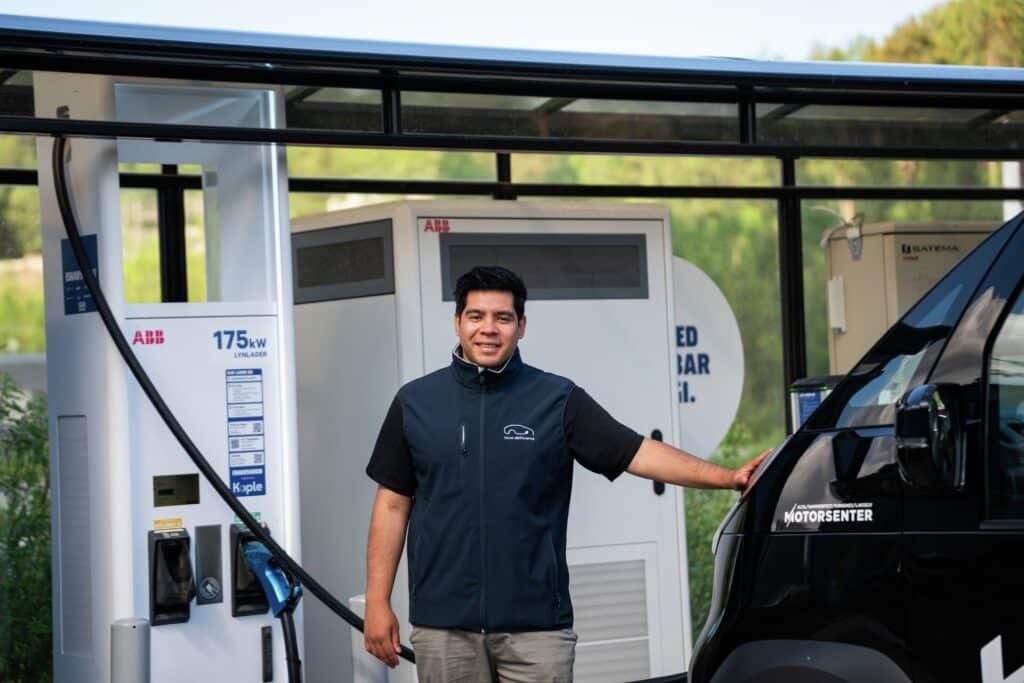
After spending three months in Norway, Diland Castro from Chile travelled to the far north. What he found was a region where long distances, few citizens and grid constraints no longer stand in the way of driving electric.

Across Latin America, discussions about electrifying the passenger car fleet often return to concerns surrounding weak distribution grids, long distances and the lack of chargers in remote areas where, given low EV usage, stations are not profitable for charge point operators (CPOs).
For Diland Castro, leader of Infrastructure and Energy at Chile’s Sustainable Mobility Center (CMS), this is why a trip to Finnmark, the long stretching county at the northern tip of Norway, was by far the most interesting.
After spending three months with the Norwegian EV Association to learn about Norway’s electrification journey, he wanted to see how the most remote regions embark on the transition.
– In Chile, around 80 % of the charging infrastructure is concentrated in the Santiago metropolitan region. In the north we face several challenges, but two stand out. With few users, a charger does not generate enough revenue to cover its costs, and some stretches have no electricity supply, which makes electrifying them difficult, Castro explains.
Driving through Finnmark on a rainy summer day, with long distances between small towns, it becomes obvious that this has not been the easiest place to electrify.
Yet today, charging is rarely a concern. Fast chargers are found across the region, and in May this year EVs accounted for 98 % of new car sales in Finnmark.
That was far from what people thought realistic ten years ago. Many of the objections still heard in parts of Latin America today were also raised in the north of Norway.
Building a network where others saw risk
When Norway’s national charging strategy was launched in 2013, Finnmark was left off the map, and despite several rounds of discussions and tenders, progress was slow.
The breakthrough finally came in 2020, when the state enterprise Enova awarded support for a network of 25 fast-charging stations across Troms and Finnmark.
At the time, Finnmark had only a handful of fast chargers and some of the longest distances between charging points in Norway.
Many of the new stations were built in remote areas where usage was expected to be low, but without them, long distance travel and connecting small towns would simply not be possible.

The breakthrough was the result of years of advocacy from the Norwegian EV Association, Finnmark EV Association, local energy companies and regional stakeholders, all working to ensure that northern Norway would not be left behind in the transition to electric mobility.
For Diland, who is from the north of Chile himself, the experiences from the north of Norway felt especially relevant. Chile has even longer distances, more remote regions and a charging network that is still heavily concentrated around the capital.
Government support for public charging has so far been limited. While the sales of new EVs keep growing, the charger deployment is not keeping up, and today 62 % of the country’s municipalities still do not have public charging.
The remaining difficulty for charge point operators is sustaining stations in places like northern Chile, that has the same low-traffic and high-cost conditions Finnmark once faced.
The challenge behind the charger
Another recurring concern for the charging network is the grid. In Chile, some relevant stretches of the road network have no electricity supply at all, which limits where charging can be deployed.
Where the grid does exist, connection times are longer than expected, and the lack of standardized documentation adds further delays. Beyond that, there is a common perception that distribution networks are too weak to support full fleet electrification.
In northern Norway, the grid has already had to handle high electricity demand during cold winters for heating. Therefore, installing home chargers in households has not created any problems for the grid capacity.
For public charging, the challenge has been less about whether the grid can handle it, but from day one, actors like Ishavskraft had to look carefully at where charging could be connected in a practical and reliable way, assessing local capacity and how to cover the cost of expected low usage for charging stations.
Furthermore, Diland Castro points to several challenges beyond grid capacity:
– We will most likely need targeted subsidies to enable chargers in priority areas with low utilization, along with better data availability, universal payment methods and interoperability between networks. In parallel, we need to speed up connection processes with the distribution companies, he says, and continues:
– One important barrier is how long it takes to enable a charger. In practice, when an operator wants to invest, connecting a station can take several months, or even years, because of grid upgrades, permits and approval processes.
This is where regulation matters. In Finnmark, local authorities, landowners and grid companies have met challenges, but the process is regulated and there are expectations for reasonable response times. That predictability has been essential when building the charging network.
Before public funding led to a breakthrough in the north of Norway, there were ideas circulating that regulation could require distribution companies to contribute to the charging infrastructure, for example by installing a basic number of charging points in the areas they already serve.
The logic was that wherever there is electricity, there should be a way to charge. This way, remote regions would not be left behind while commercial operators wait for a profitable business case.
It has to work as a network
Finnmark is not without challenges. Cold winters still affect range and charging performance, preheating the battery is often necessary, and drivers need to plan better in demanding weather.

However, what was once Norway’s biggest charging gap is now the best example of how public support, local energy companies, political pressure and long term advocacy can make electric mobility possible in a region where many might have expected it to fail.
In Chile, EV sales are rising and the country has made deliberate progress on the rules that govern charging. The challenge is for that progress to also reach charging infrastructure development outside the largest cities, where the market has been slower to arrive
The question is not only how to finance chargers, but how to create the rules that make the network possible. For it to work in the remote regions of Chile as well, it will take the right incentives, a state that enables the strategic corridors, and a private sector that achieves coverage by taking on the cost in the least profitable areas.
If it works in chilly Finnmark, it can work in the far north and south of Chile.