The Mission to Faster Electrification of Mobility in South Africa:Those Who Do Not Pollute Pay Extra
Denne artikkelen ble oppdatert for over ett år siden, og kan inneholde utdatert informasjon.

In Norway, the cars that pollute the most pay the highest taxes. In South Africa, it is the opposite.

There, cars drive on the left side of the road, the sun is in the north at midday and the cars that pollute the least, namely electric cars, have the highest taxes.
Through external funding from the America based climate foundation ClimateWorks, the Norwegian EV Association has had the opportunity to take a closer look at electric car development in five emerging economies.
This funding has also enabled us to assist similar organizations in select countries, helping to amplify the voices of electric car drivers and contribute to a faster adoption of electric cars.
On August 6th 2025, The Norwegian EV Association and Electric Mission from South Africa co-hosted a webinar about the joint work and findings about the South African car taxation system, and what the key takeaways from Norway are, that could increase local demand of electric vehicles in South Africa.
Report on Purchase Taxes
In 2024, the South African not-for-profit organization Electric Mission and the Norwegian EV Association collaborated on a study of taxes for new car purchases in South Africa.
They are surprisingly high.
When new cars are first registered in South Africa, there is an import tax and a ‘luxury’ tax (Ad Valorem – above a specific value), both of which are calculated based on the value of the car.
The rate of VAT is significantly lower than in Norway, but in South Africa, unlike in Norway, VAT is also calculated above the other purchase taxes, therefore the total VAT is approximately at the same level.

In November 2024, the Electric Mission and the Norwegian EV Association had stakeholder meetings in Johannesburg, Pretoria and Cape Town to present the findings of the study to authorities, the automotive industry and sector-related organizations. The Norwegian Embassy in South Africa also arranged an event with various key stakeholders.
There was great interest in the work, including a meeting with the Ministry of Finance of South Africa which 13 bureaucrats across multiple divisional departments attended.
The Taxes Act as a ‘Brake’ on the Growth of the Electric Car Market
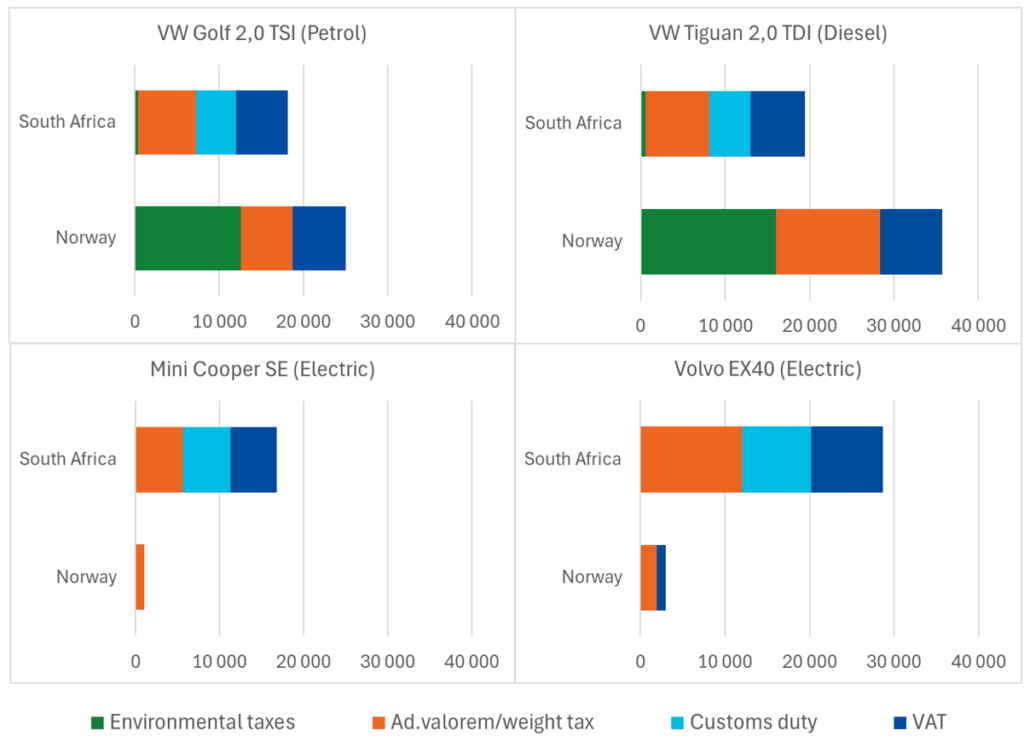
Since electric cars are currently more expensive to produce, this means that all taxes will also be significantly higher for electric cars.
When this is added to cars that are initially more expensive, the tax system acts as a brake on the electric car market development in South Africa.
Denmark also has a value-based registration tax, while in Norway the tax is mainly calculated based on the car’s CO2 emissions.
As electric cars are exempt or have low registration taxes in the two Nordic countries, these taxes act as catalysts for increased electric car sales, with an electric car share of 51.5 percent in Denmark and 88.9 percent in Norway in 2024.
The report proposes adjusting the registration taxes of electric cars lower than the taxes on fossil cars in the same segments in South Africa.
We have completed calculations on how this will affect four different car models, comparing a small and a large electric car with equivalent fossil cars. The report also compares the taxes on the same cars in Norway.
In the figure below, we see the purchase taxes on a Volvo XC40 (equivalent) compared to a Volkswagen Tiguan diesel – and a MINI Cooper compared to a Volkswagen Golf petrol car.
Only Fossil Fuel Based Car Production
There are several car assembly factories in South Africa, with the highest production capacity of around 600,000 cars, where over half of these are exported, mainly to Europe.
None of the factories produce electric cars, only four hybrid models.
The share of electric cars in new car sales in 2024 was a mere 0.38 percent, significantly lower than in comparable countries such as Brazil (3.2 percent) and Turkey (10.3 percent).
The South African car industry is dominated by «the big seven», namely BMW, Ford, Isuzu, Mercedes, Nissan, Toyota, and Volkswagen, all of which benefit from government incentives from local production against imports.
The tariff protection only applies to car manufacturers producing more than 50,000 cars in the country. In recent months, South African authorities have had discussions with both Tesla and BYD about setting up factories to produce electric cars, while «the big seven» currently have no official plans to do so.
Import Regulations Result in Higher Import Duties for Electric Cars
Most car manufacturers focus on producing selected car models at their factories in South Africa, but they also apply to the Ministry of Trade, Industry and Competition to import other models from their brand with an offset of import duties against their local production.
In the trade agreement with the European Union, European sourced cars have lower import duties than imports from the rest of the world, but electric cars are excluded from this agreement.
Generally, the rate is 25 percent of the car’s value before taxes, with an exception for fossil fuel cars and hybrids from EU, which have an 18 percent customs duty.

For the registration taxes, the import duty is generally higher for electric cars, as it is also value-based.
The report does not propose any immediate changes to the import duty, as the tariffs are within the trade negotiations which are due to be discussed in the next review period.
However, the import regulations should be adjusted over time so that they do not serve as an additional barrier to the sale of electric cars.
Polluters Should Pay
In Norway, the cars that pollute the most pay the highest taxes.
This principle has led to cars with emissions facing increasingly higher fees, and as electric cars have improved and gained longer range, they have taken over the new car sales in the country.
Norway has been an early adopter and has the world’s most ambitious zero-emission goals, aiming for all new car sales to be zero-emission by 2025.
Emerging economies do not necessarily have the same financial capacity to prioritize as powerful measures as Norway has implemented.
Therefore, in the report, we propose that authorities use the existing car taxation system in a way that does not reduce state revenue from purchase taxes, but instead balance the taxes for electric cars and fossil fuel cars while placing more emphasis on the emissions profile.
The first figure below shows the current situation. The next figure shows how the proposed changes to car taxes will make electric cars (Volvo CX40) cheaper than they currently are, and fossil fuel cars (Volkswagen Tiguan) be relatively taxed on their corresponding emissions.
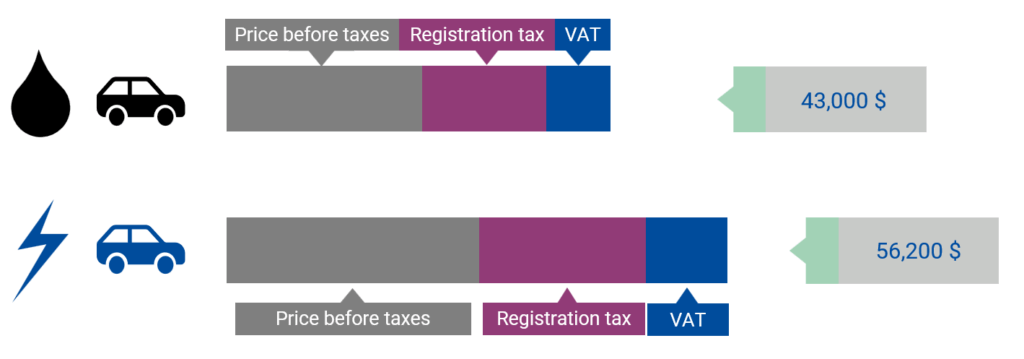
The current situation in South Africa is that those who do not pollute, have to pay extra. This is not a sustainable principle. “If organizations such as the Electric Mission can help the South African industry to start local production of electric cars, it would be a good thing”, says Secretary General Christina Bu of the Norwegian EV Association.
– The electric vehicle market in South Africa has been growing year-on-year since 2013, but at a much slower rate to international regions – both developed and developing, says Hiten Parmar, Executive Director at the Electric Mission. He continues:
– Boosting local electric vehicle adoption initially is vitally important and will stimulate existing vehicle manufacturers towards local production for our current markets, resulting in economic growth and creating the opportunity for growing export opportunities, as targeted within the South African Automotive Masterplan 2035.
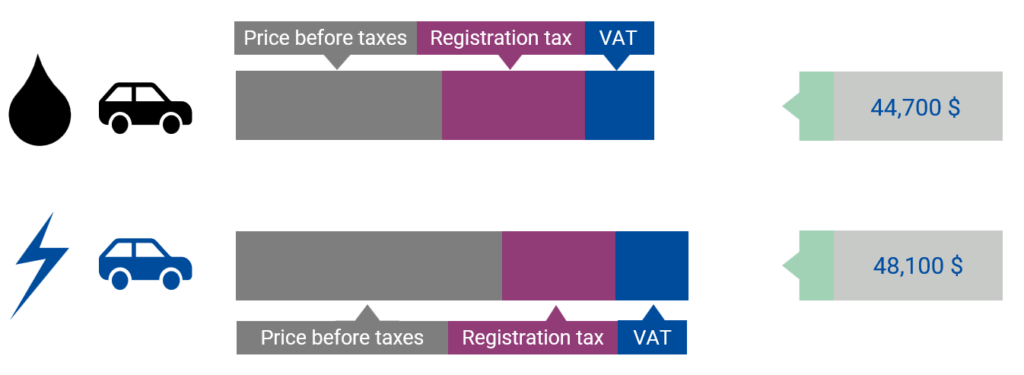
What the report has shown in the example will also apply in general. An electric car that is currently much more expensive than a comparable fossil-fuel car will then be able to get about the same price in the store.
This way, South Africa can get more of what they want, which is increased local demand for electric cars, and less of what they don’t need, namely new cars with emissions.