Europe’s Truck Lobby Opposes Electrification
Brussels, December 16 – In a surprise move, the European Commission has announced changes to truck emission standards that could significantly delay the shift to electric heavy-duty vehicles.

This was announced as part of a previously signaled package for the automotive industry, where the Commission is giving in to long-standing and massive pressure from the European car industry. The move weakens European regulations and removes the requirement for zero emissions from 2035 for vans and passenger cars.
Few expected that changes to truck regulations would also be included now.
From Price Collusion to Weakening Climate Regulation
The European truck market is dominated by a handful of players. Three of them are German: Daimler, MAN, and Scania – both Scania and MAN are owned by Volkswagen. In addition, there is Sweden’s Volvo, America’s DAF, and Italy’s Iveco.
In 2016 and 2017, all companies except MAN were fined heavily for long-term illegal cartel activity. MAN escaped penalties by blowing the whistle.
Today, the truck manufacturers have joined forces again – this time to weaken emission regulations for trucks.
A Letter to the European Commission
In October, truck makers sent a joint letter to the Commission requesting generous credits that would soften emissions targets. According to Transport & Environment, this concession will result in 25,000 fewer electric trucks by 2030.
They got exactly what they asked for.
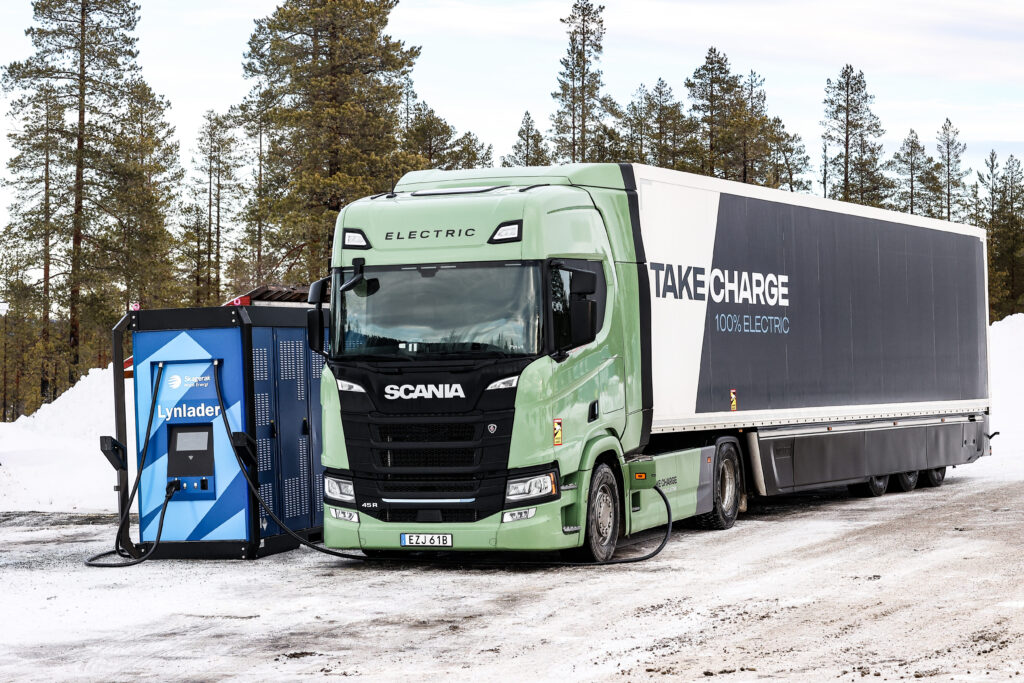
Volvo and Scania already exceed the current 2025-2029 targets and will accumulate large credit reserves to offset stricter requirements in 2030. In practice, EU rules are now so lenient that manufacturers won’t need to ramp up electric truck production until close to 2035.
With Brussels stepping back, individual member states must step up with national measures to boost demand.
The Same Story Unfolds in the U.S.
European truck giants also dominate the U.S. market – and have fought similar battles there. In 2023, they pledged to comply with California’s tougher climate legislation. But when Donald Trump returned to the presidency, they quickly sought to withdraw.
In August 2025, Volvo, Daimler, and Volkswagen’s U.S. brand International, along with Paccar (known as DAF in Europe), sued California to enforce Trump-era policies.
The lobbying victory means EU climate policy now offers little incentive for electric truck production over the next decade.
Global environmental groups have urged the companies to drop the lawsuit.
Few and Expensive European Electric Trucks
Enova, a Norwegian government agency that supports the transition to low-emission energy solutions, reports that a diesel tractor unit in Norway costs about €140,000, while an electric equivalent costs around €340,000 – a staggering price gap.
European manufacturers lack dedicated production lines for electric trucks and produce only a few thousand units annually, a likely reason for the high costs.
Challengers Are Lining Up
The market may find solutions beyond Europe. In China, electric trucks sell for under €250,000 and have achieved a market breakthrough.
According to UK-based Business Monitor International, electric trucks account for 46% of truck sales in China this year, and they expect the share to rise to 60% by 2026.
China’s largest electric truck manufacturer, Sany, already produces ten times as many electric trucks as Scania and Volvo and plans to enter Europe in 2026.
Meanwhile, BYD is building a truck factory in Hungary, and Tesla aims to produce 50,000 electric trucks annually once its Nevada plant opens in 2026.
Global startup Windrose, planning factories in Belgium and France, recently announced its electric tractor unit E700 will sell for €250,000, with deliveries starting in early 2026.
The Battle Is Not Over
Europe’s truck lobby may have won this round – but the future of the market could look very different from what traditional manufacturers expect. New entrants with significantly lower prices and aggressive production plans are poised to disrupt the industry and capture substantial market share.
If Europe’s truck makers fail to accelerate electrification, they risk losing their dominant position – not to regulation, but to competition.